About
The people who answer are the people who build.
RelentNet is Brandon Harris and Daniel Velez. We met playing video games, worked at the same IT company, and started this in May 2022 to do that kind of work with a fraction of the overhead.
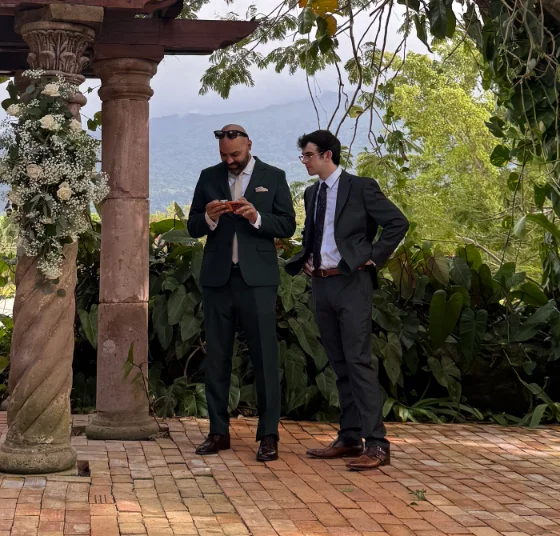
- Brandon Harris
- Nashville
- Co-founder & CEO
- Daniel Velez
- New Orleans
- Co-founder & COO
Daniel was Brandon’s boss. He owns Function IT Services, a hardware IT company he still runs, and Brandon was a designer there. In May 2022 Brandon pitched him something different and the hierarchy quietly inverted.
There is nobody between you and the work. We scope it, write it, host it, and answer the phone. When a project needs a specialist we bring one in, and you will know that we have.
How it started
Brandon pitched it over Discord.
We met years earlier playing video games, through a mutual friend, on the same platform. Brandon wanted to be more creative and, in his words, not stuck in someone else’s cog. The pitch was a business doing the work we already knew how to do, with a fraction of the overhead of the company we were doing it at.
Daniel agreed, and for the first two years he covered Brandon’s living costs so Brandon could commit to it properly. The company earned from the start. That was Daniel investing in Brandon, not Daniel funding a company.
The first job was five websites for a group of truck plazas, at three hundred dollars each. Brandon’s assessment now: a gross undervalue. We have been correcting for it ever since, and what to charge is still the thing we argue about most.
How the work splits
One of us builds it. One of us runs it.
Brandon owns what gets built: the vision, the code, the design. Daniel owns bringing the work in and keeping it running. We both sit in client meetings, so neither of us is ever repeating something secondhand.
Brandon is in Nashville and Daniel is in New Orleans, which is why the map looks the way it does: Tennessee, Louisiana, Georgia and Florida, reachable without booking a flight. Most clients never need us in the room. We offer it anyway.
What we will tell you
Sometimes the answer is don’t build yet.
Clients know what they want. They usually do not know how they want it, and that gap is where the money goes. So a diagnostic can end with don’t build yet, and it does. We have turned work down because a business was not ready for it and said so rather than take the money. It cost us the job.
The harder conversation is the other one: that the site has to come down and be rebuilt, and that it will cost more than expected. Nobody enjoys hearing it. Everybody is glad about it afterwards.
Why we keep the keys
Late 2025, and nobody noticed.
A remote code execution flaw surfaced in React and Next.js server components at the end of 2025. Brandon updated almost every client site and service to get ahead of it while Daniel swept the servers. Not one client was affected, and most of them never learned there had been anything to be affected by.
That is the whole argument for staying on after launch. Software does not hold still, and somebody has to be watching it who is not you.
Where this goes
About eight people, eventually.
Big enough to run without either of us at the helm. Small enough that we still know every customer by name. We are not trying to be large, and we bring in specialists per project rather than hiring for work we do not have yet.
In the meantime we share every credential and everything we know, deliberately. Either of us could run this alone if it came to that. Neither of us wants to.
Start with the workflow.
We will tell you if it needs building.
01
Book a diagnostic
Free, and it commits you to nothing. It ends with one of three answers: build, connect, or don’t build yet.
02
Call
You reach the people who would design and build the thing, not an account manager.